Average Reviews:

(More customer reviews)The day before I wrote this review, New York Newsday published a telling story about education in New York City. Teachers in multiple subject areas were nearing open revolt over being forced to adopt the latest pedagogical fad, something called the "workshop model" that limits instructors to just ten minutes of direct instruction each period. Students are then supposed to work in groups for 25 minutes, after which the teacher is granted a five-minute closing. In some schools, administrators were actually "writing teachers up" for not adhering to the workshop model, the equivalent of a formal reprimand.
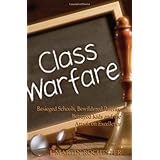
How can anyone teach chemistry or physics or math with just ten minutes of daily lecture time? Martin Rochester would no doubt happily cite New York's implementation of the "workshop model" as another instance of progressive miseducation. In his book CLASS WARFARE, Rochester takes on the progressive education establishment, represented in large part by school boards and university schools of education. In the author's view, the war is between traditionalist parents and progressive educators, and he sees the parents (and their children) losing most of the battles.
Rochester draws heavily on first-hand experience as an activist parent in the Clayton school district, near St. Louis, where he estimates he has attended 275 out of 280 school board meetings since 1988. He also bases his arguments on observations of students' work at University of Missouri - St. Louis, where he is a professor of political science. Over the course of five core chapters, he tackles the big issues of modern pre-collegiate education: ability grouping (or tracking), multiple intelligences theory, the self-esteem movement, "back to basics" versus fuzzy math and whole language instruction, and the teacher-as-facilitator model of constructivist education. In each case, he sees these approaches as lowering standards and expectations, teaching to the bottom and suppressing the top, and avoiding conflict and accountability. Rochester approaches each topic with an entertaining and informative mixture of published sources, expert opinion, and personal anecdotes.
CLASS WARFARE contains some powerful and important messages about the American public school system. Having said that, it is important to note that his message comes in a badly flawed package. To begin with, Rochester's approach is one-sided in the extreme, as if all progressive ideas were equally deleterious to American education, without any redeeming qualities. Having taught math in a New York City high school for six years, and being a traditionalist myself, I can say with absolute certainty that such a position is wrong.
Second, the author's tone is far too cynical, packed with bitter sarcasm, ad hominem attacks, and nonsensical slippery slope arguments that weaken his case. Instead of the balanced critical voice of a Diane Ravitch, Rochester comes off as a barely subdued version of Rush Limbaugh or Bill O'Reilly. Consider for example, his dismissal of Rousseau's views of pedagogy by accusing the eighteenth century philosopher of "abandoning all five of his children while they were infants," a typically Limbaugh-style ad hominem attack. Or his childishly petty categorization of a statement by Bob Clapp, an instructional technology specialist at U of M - St. Louis, as "clap-trap." Or, "if NCTM had told these folks to jump off a cliff, they would have done it, but not before telling us what a wonderful idea it was." Or that "some of the people behind these reforms may well have been hit in the head by one dodgeball too many when they were youngsters...." Or his corny adoption of the name "Deep Rote" to identify his insider source in the St. Louise school district.
Third, after spending seven chapters trashing every progressive notion about education from the last fifty or more years, Rochester's sudden call in Chapter 8 for a "balanced pedagogical paradigm" stands in sharp contrast to the preceding 220 pages of his book. More insidiously, his solution includes a strong but undefended recommendation for school vouchers, not on the grounds of pedagogy, but on the democratic grounds of increased choice. Perhaps his real agenda sneaks out in this last chapter when he (inadvertently?) refers to public schools as "government schools" (page 236) and when he says on page 227 that public schools "are likely to remain the primary educational service provider in America for years to come." Likely? One can hardly escape the sense that Rochester would prefer otherwise.
Prospective readers should take note that Encounter Books is a highly Conservative publisher, having produced attack books on Hillary Clinton, Noam Chomsky, and most recently, the environmentalist Judi Bari. Encounter is backed by the right wing Bradley Foundation (financial supporter of the classic right-wing smear book, THE REAL ANITA HILL by David Brock as well as THE BELL CURVE) and the Olin Foundation, among others. Nevertheless, many Conservative views on education have merit, and our national education system needs a healthy debate between traditionalist and progressive positions.
Despite its faults, I strongly recommend CLASS WARFARE. Read Martin Rochester's book with a grain of salt, and then do as he has done - attend your community's next Board of Education meeting.
Click Here to see more reviews about: Class Warfare: Besieged Schools, Bewildered Parents, Betrayed Kids and the Attack on Excellence


No comments:
Post a Comment